My Thoughts on the Master and Margarita
Spoiler Alert
9/9/26
I knew going into this book that I would need a lot of context of Russia during that time period especially political context. I knew the central themes of the story included censorship and I picked the book up in a time where I had felt that the language in the media started to sound rehearsed or coached and instead of fully conspiring of why I felt that way; I decided to read a story about it.
Mikhail Bulgakov worked as a physician prior to his work as a playwright/writer. During this time those who wrote plays also wrote novels. Just like his self insert (the master), Bulgakov received a lot of criticism; an instance in 1930 where he got 301 reviews. Out of those 301 reviews, 298 were negative but the positive review he did receive one of them were Joesph Stalin. This is notable as well as the fact that Stalin attended one of the plays of Bulgakov called The Days of the Turbin based on Bulgakov's novel The White Guard over fifteen times!
A quick search of what the story is about tells me it was a self biological story written by Bulgakov, where he speaks in the experiences of himself and his family and their roles during the anti Communism wartimes against the Red Army. I want to note this story does seem episodic and the first releases were in magazine articles. His brother served the White Guard and he was drafted as a doctor. Stalin liking this play was shocking due to Stalin being a villain in this play as well. It is documented that Stalin liked this play because it made the Bolsheviks look impressive therefore Stalin would look even more impressive for defeating such an adversary. If I am being honest; I would love to read about Bulgakov's experience as a combat physician; it is a truly unique perspective. And frankly, there are some parts of the story that I recognized as someone who has seen a broken system from both sides.
It is reasonable to say that Stalin and Bulgakov had a weird relationship; it is hard not to make comparisons; I imagine that it kinda similar to DJT going on SNL but instead of trying to seem relatable or charismatic; Stalin seemed to have a sense of weird pride over the satire. Upon my armchair research, it says that DJT has seen Les Misérables a "number of times" so I guess they share the same exact experience, perhaps the Handmaid's Tale will be next for him. Anyways, Bulgakov would have been probably executed if he was not talented. Bulgakov is an excellent writer; I am truly impressed by how human and grounded the story and characters were despite being so surrealistic. However, the political context did warrant further investigation on my part which did take extra time.
The novel begins with some editorial conversation on a piece written by Ivan Homeless and his boss Berlioz. Basically Berlioz did not favor how Ivan Homeless wrote Jesus Christ, or as he is called in this book Yeshua. Another reason why this book intrigued me was because this story contains many biblical themes in Moscow where there was state mandated atheism. Upon reading this book, I did not realize that people of this time were paid by the government to write propaganda. Ivan Homeless made Yeshua "sound too real" despite writing about Him in a negative light.
A foreign stranger overheard this conversation and at first was giddy. A whole city that did not believe in God? However as the three of them continue their discussion, they discuss the "five proofs" which are actually called Five Ways (Quinque Viae) written by Thomas Aquinas . Kant wrote the Critique of Pure Reason which does "contradict" some of the proofs in some people's eyes. But unless I am wrong, I feel like they are saying the same concept just from different perspectives. So basically Thomas Aquinas and the Catholic argument is that Reason comes from God and we cannot fully comprehend God so He exists both within and beyond human reason. God is the creator so he was uncreated (eternal). Also if everything could stop existing in a finite sense (I think) then everything right now would cease to exist soley due time having passed (plenty of it!) therefore God that has always existed; making him the alpha and omega. It is hard for me to speak of my beliefs in this snooty "philosophical" language as opposed to how I personally know God and the story of Creation. So the "sixth proof" which is basically Critique of Pure Reason written by Immanuel Kant. So basically, what Kant claims is that because reason alone cannot prove that God exists because God lives outside of human reason therefore God is proven by morality not reason. 😂😂😂. Exploring these topics on my own time in the lens of this story actually makes me realize why I hated that philosophy class and professor in my freshmen year of college. When reading about what Kant is claiming I can't help but laugh and feel like I am talking to a former flat earther that recently climbed a mountain and seeing the horizon curve in the distance. Like I am not really sure what the claim is ....."because God has higher ability to reason than humans then he must not exist" seems a little easy; as if Kant was looking for an out to not agree with the five proofs but not enough of an out to fully "disprove God." Pope Francis has said that "religion without encounter is just philosophy "and I also think that is why I find it so extremely boring and void. It doesn't sound intelligent, it sounds like robotic. "The First Mover" instead of My Creator alone is a huge change in language that I just find silly. But I digress, most of Moscow disagreed with both Aquinas and Kant.
The foreigner after humble bragging that he has shared breakfast with Immanuel Kant realizes that the people of Moscow believe not only believe that Kant is wrong but also that humans self govern themselves and that humans alone keep order of the earth. The foreigner thinks this is laughable because humans cannot even live for one thousand years. This is when the foreigner tells Berlioz and Ivan about a man who slips and falls under a tram car. Then as the conversation concludes the foreigner says to Berlioz that while involving sunflower oil, Berlioz will die by getting his head chopped off by a Russian woman. This is said in a very matter of fact way in a similar sense of someone "reading your birth chart." Again, Bulgakov really fleshes out a lot of the symbolism in the minor details of the story. Before going their separate ways, the foreigner identifies himself as W, a specialist in black magic and assures both Berlioz and Ivan Homeless that Jesus did exist.
The second chapter goes back to the time of Pontius Pilate on the day of the crucification of Jesus Christ or Yeshua (the story goes back and forth in the beginning between both names.) If you are familiar with this story of jesus going on trial before Pontius Pilate, you have enough context but if you do not; I would brush up on it. It is good to know the gist.
When I learned of Pontius Pilate, it was in the context of the Jewish people demanding Pilate to crucify Jesus despite there being no reason to do so; even to the point of sparing someone who was actual guilty of an actual crime. I then more recently have been moved by the story of Jesus flipping tables in the Den of Thieves just to find out it was a catalyst to His own crucifixion.
Making that connection along with Judas turning Jesus into the authorities makes a lot more sense to me. Jesus questioned "authority" with True Authority. The Pharisees were profiting off people who bought animals to sacrifice in the temple; making God's house into a common mall. Jesus was right to question these people and what do they do? Obviously God's will is the right way but it just makes the whole experience that more impactful. Jesus Christ was about to make the ultimate sacrifice for us; so it was fitting that the catalyst related to sacrifices. Also, I have heard commentary that the tables Jesus went to flip were tables that sold doves; which is what His family would have most likely bought to make the temporarily needed sacrifices. It just shows how connected Jesus was to this world during His life on earth.
Bulgakov could have easily chosen Judas to be the person who struggles with guilt for an exorbitant amount of time but I feel it is a lot easier to sympathize with cowardice than it is to greed especially in this context. There aren't a lot of people who would sympathize with Judas; even today. What I feel? I have no room to judge Judas because I have also given into sin and temptation; I just hope that if it ever did come down to something meaningful I have the ability to step up. When exploring the context of being a good person in a corrupt system, I think Pontius Pilate is a perfect character to write about. I imagine that people wouldn't do air quotes while saying "I was just following orders" at the time of writing this novel; but it is exactly the same idea. In the Master and Margarita, not only did Bulgakov emphasize that Jesus was innocent (because He was!) but also to showcase that jesus is God, by having Yeshua heal Pilate of his debilitating migraines instantly. It is great groundwork for the question of what happens to our society when being a good person becomes expensive? Where exactly do our individual choices start to matter in a system that controls what our choices are? What do we owe ourselves when development of character does not equate to good social standing? It warrants asking ourselves if should even allow a government or system to dictate our morality.
Some verses I find similar to the conversation that played out in this story was originally the classic Scripture passage that I had more familiarity with:
Then Pilate asked Him, saying, “Are You the King of the Jews?” He answered him and said, “It is as you say.”So Pilate said to the chief priests and the crowd, “I find no fault in this Man.”But they were the more fierce, saying, “He stirs up the people, teaching throughout all Judea, beginning from Galilee to this place. ( Luke 23 : 3-5)
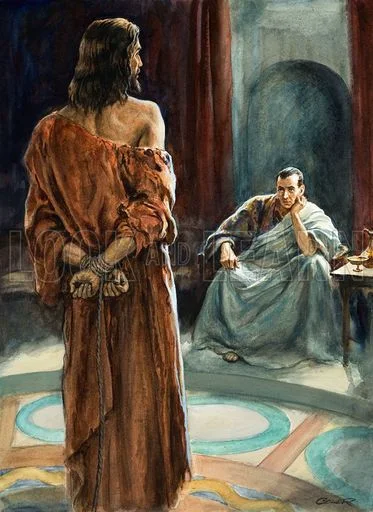
But upon some more armchair research I find that this reflects more of the conversation.
Jesus answered him, “I spoke openly to the world. I always taught in synagogues and in the temple, where the Jews always meet, and in secret I have said nothing. Why do you ask Me? Ask those who have heard Me what I said to them. Indeed they know what I said.” And when He had said these things, one of the officers who stood by struck Jesus with the palm of his hand, saying, “Do You answer the high priest like that?” Jesus answered him, “If I have spoken evil, bear witness of the evil; but if well, why do you strike Me?” (John 18: 20-23)
Basically Pilate and Yeshua speak on his innocence and if there are good or evil people in the world. Yeshua says there are no evil people in the world. Pontius Pilate disagrees. Later in the story Pilate basically goes around basically looking to blame anyone else for the fact of not stopping the crucification of Christ. Long story short, this is all a buildup to Pilate feeling this immense guilt over the cowardice that he succumbed too when ultimately making that decision ; not fully understanding why...He does acknowledge that Yeshua was an innocent man, but there was something more to Him. Bulgakov writes in a way where he wants you to more so feel and perceive as the character while remaining in the narrative. It is often used as a lens to the story. Pilate starts feelings intense guilt and unrest and there is a storm brewing around him so the language and imagery could easily be describing the actual weather as well as the internal state of Pilate. We leave him sitting in a trance of rumination with his dog, Banga , sitting beside him. The two of the sit and wait; not knowing if what they are waiting will ever come to surpass.
The third chapter is called the Seventh Proof as we enter back into Moscow at 10 am same time that it was with Pilate. In this chapter, what was foretold by W came into fruition. Berlioz slipped due to another woman dropping her groceries and when Berlioz fell into the tramcar railway; a female conductor could not stop the train in time. Ivan Homeless (rightfully so) was really freaked out by these series of events and started to run after the black magician and his two accomplices who did have a role to play in the death of his colleague that he was just sharing a nice warm apricot soda with. The chapter of The Chase was excellent and by far one of my favorite chapters of the book. Eventually, Ivan Homeless goes back to his hangout spot and is crazed by the situation to the point where the medics came and brought Ivan Homeless to the psychiatric ward. The doctor who was speaking with Ivan Homeless was keen and sympathetic to the situation Ivan Homeless was going through but it was very clear that the Dr. didn't necessarily care to solve the problems of Berlioz dying and how that happened; it was more so concerned with the psychological trauma that Ivan Homeless was currently going through. It was as if Bulgakov was utilizing his feelings on how the Soviet Union was actively hurting himself and his patients but there was only so much he could do within the limitations of his roles and responsibilities as a Doctor that works for a system that has no regard for it's people.This hospital is where Ivan Homeless meets and befriends the Master.
Upon meeting, the Master tells Ivan Homeless (a younger writer who works as a poet/propagandist) about the criticism he faced when writing the story of Pontius Pilate. I imagine the chapters about Pilate is the novel of the Master; which helps to make sense of the jumping back in forth while reading The Master and Margarita. The Master also speaks a bit on his true love but I might have to reread some passages of the book for now. But I do want to discuss Margarita but she literally gets introduced towards the middle of the novel.
To be Continued..